
Defense Bid Managers: Turn CPV, NAICS and UNSPSC Into Win-Ready Pipelines

For bid managers in the defense and security sector, identifying and qualifying relevant tender opportunities is a complex, high-stakes endeavor. The challenge is magnified by the fragmented nature of global procurement, where different countries and agencies use varying classification systems like CPV, NAICS, and UNSPSC. Reconciling these disparate taxonomies can be a significant drain on resources, leading to missed opportunities or inefficient pipeline management. This article will demonstrate how TendersGo's Procurement Classification Intelligence empowers defense bid managers to normalize these inconsistencies, automate opportunity routing, and transform classification codes into a repeatable, win-generating workflow.
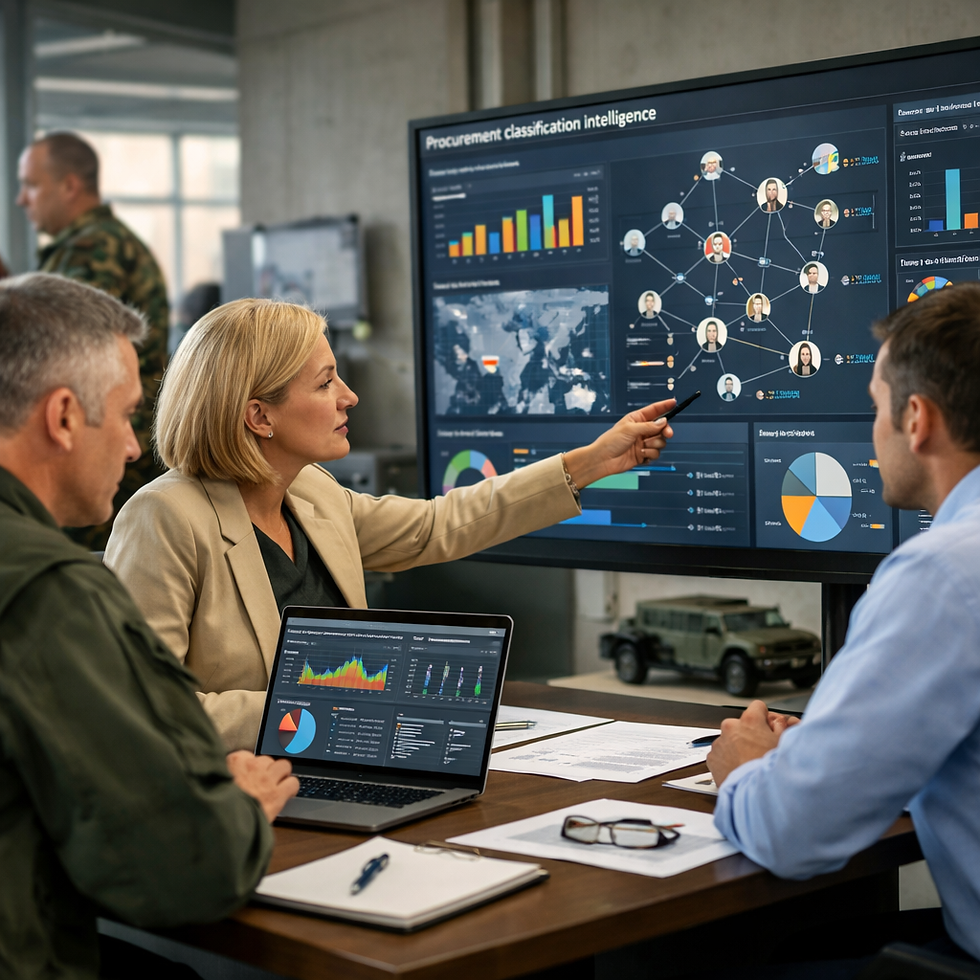
Procurement Classification Intelligence is TendersGo’s specialized layer for finding and standardizing opportunities using CPV (Common Procurement Vocabulary), NAICS (North American Industry Classification System), and UNSPSC (United Nations Standard Products and Services Code) across diverse procurement sources. This capability is crucial for bid teams seeking consistency across international borders and internal systems. It allows users to filter tenders by these formal classification codes, creating highly precise, classification-based searches that cut through the noise of general keyword queries.
What is Procurement Classification Intelligence and Why Does it Matter for Defense?
At its core, Procurement Classification Intelligence in TendersGo is about enabling precise and standardized discovery of tenders, regardless of their origin or the specific taxonomy used by the issuing authority. For defense and security, this means:
CPV (Common Procurement Vocabulary): Predominantly used in the European Union, CPV codes cover a vast range of goods, services, and works. For defense, this could include everything from military equipment and maintenance services to IT infrastructure for secure communications or construction of barracks.
NAICS (North American Industry Classification System): The standard used by federal statistical agencies in the United States, Canada, and Mexico. Defense bid managers targeting North American contracts will encounter NAICS codes for aerospace manufacturing, defense contracting services, research and development in defense, and more.
UNSPSC (United Nations Standard Products and Services Code): A global standard for classifying products and services, often adopted by large organizations and governments worldwide for spend analysis and procurement. This might apply to tenders for specialized security software, logistics support, or humanitarian aid equipment.
The significance for defense bid managers lies in TendersGo’s ability to normalize these disparate codes. Instead of manually cross-referencing and translating between systems, bid teams can use TendersGo to filter tenders by CPV, NAICS, or UNSPSC, even when the original notice might be in a local language. This ensures that a tender for "unmanned aerial vehicles" in France (CPV), "aerospace product manufacturing" in the US (NAICS), or "drone systems" in Australia (UNSPSC) can all be identified and categorized under a consistent internal framework, streamlining the bid qualification process.
The Workflow: Turning Classification Codes into a Repeatable Bid Generation Process
TendersGo’s Procurement Classification Intelligence isn't just a filter; it's a foundational element of a repeatable bid-generation workflow. Here's a practical step-by-step approach: Define Your Core Capability: Start by clearly articulating your company's defense or security offering. For example, "secure tactical communications systems" or "border surveillance technology." Translate to Classification Codes: Use TendersGo's search interface or the AI Assistant Natural-Language Search to translate your capability into relevant CPV, NAICS, or UNSPSC codes. The AI Assistant is particularly useful if you're starting with mission-oriented language rather than specific codes. Apply Advanced Filters: Navigate to TendersGo's Advanced Search & Filtering . Here, you'll apply your chosen classification codes. You can combine these with other critical filters such as:
Geography: Narrow down to specific countries, regions, or even continents where your defense solutions are most relevant. TendersGo covers 220+ countries and allows filtering by 29 continents/regions.
Organizations/Agencies: Target specific ministries of defense, national guard units, intelligence agencies, or other government bodies that are key accounts.
Keywords: Refine your search with specific keywords, using "Exact Match," "Mentions," or "Any" to capture nuanced requirements.
Sectors: Leverage TendersGo's 77 sectors and industries to ensure alignment with broader defense and security categories.
Review and Refine Results: Examine the initial search results. TendersGo presents these with clear indicators, and for verification, often exposes original source pages or live PDFs. Adjust your filters as needed to optimize relevance.
Save and Automate Monitoring: Once satisfied, save your search and activate unlimited alerts. This transforms a one-time query into a continuous, automated monitoring system that feeds new, classification-matched opportunities directly into your pipeline.
Analyze and Report: Utilize TendersGo's Analytics & Market Intelligence Reports to summarize your filtered opportunities. This provides valuable insights into demand patterns, geographic distribution, and deadlines, which can be crucial for strategic planning and leadership reporting.
Integrate for Seamless Workflow: For enterprise-level operations, leverage the TendersGo API & Data Integration to feed this classification-normalized tender data directly into your internal CRM, business intelligence (BI) dashboards, or other bid management systems.
Practical Use Cases for Defense and Security Companies
Here are five concrete ways defense bid managers can leverage TendersGo's Procurement Classification Intelligence: Building a Global Defense Pipeline for Specific Equipment: A manufacturer of specialized armored vehicles needs to track tenders worldwide. They use TendersGo to set up a saved search combining CPV codes for "military vehicles" (e.g., 35411000-7) with NAICS codes for "heavy duty truck manufacturing" (336120) and UNSPSC codes for "military transport vehicles" (25172000). They then add geographic filters for NATO countries and key emerging markets, ensuring all relevant notices are captured and consistently categorized. Monitoring Cyber Security Contracts Across Jurisdictions: A cyber defense firm specializes in securing critical national infrastructure. They create a TendersGo search using CPV codes for "IT security services" (e.g., 72315000-8), NAICS codes for "computer systems design services" (541512) with a focus on security, and UNSPSC for "cyber security solutions" (43233203). This allows them to identify opportunities from defense ministries, intelligence agencies, and critical infrastructure operators globally, regardless of the classification system used. Strategic Account Planning for Key Agencies: A defense contractor wants to deepen its engagement with the US Department of Defense and the UK Ministry of Defence. They use TendersGo's Organization & Buyer Intelligence to filter tenders specifically from these agencies, then apply classification codes relevant to their core offerings, such as "aircraft parts manufacturing" (NAICS 336413) or "defense research services" (CPV 73400000-2). This provides a targeted view of all relevant procurement activities from their most important clients. Automating Regional Opportunity Scouting: A large defense conglomerate has regional bid teams in Europe, North America, and APAC. They establish standardized TendersGo saved searches for each region, incorporating relevant CPV, NAICS, or UNSPSC codes for their product lines (e.g., naval systems, aerospace components, ground support). Each regional team receives automated alerts directly into their workflow, ensuring they are instantly aware of new, classification-matched opportunities without manual screening. Market Sizing and Demand Analysis for New Technologies: A company developing advanced AI for battlefield intelligence wants to assess global demand. They use TendersGo to search for tenders related to "artificial intelligence" (CPV 72246000-5), "data analytics services" (NAICS 541519), and "machine learning software" (UNSPSC 43233207). By running these classification-based searches and then exporting analytics reports , they can identify which countries and agencies are investing in these areas, helping to inform their R&D and market entry strategies.
Connecting with Other TendersGo Capabilities
Procurement Classification Intelligence is powerful on its own, but its true potential is unlocked when combined with other TendersGo modules:
Advanced Search & Filtering: This is the primary interface where CPV, NAICS, and UNSPSC codes are integrated with a rich set of other filters including geography, buyers, dates, values, currencies, and sophisticated keyword matching methods. It allows for the construction of highly granular and relevant search queries.
AI Assistant Natural-Language Search: For bid managers who think in terms of mission requirements or capabilities rather than specific codes, the AI Assistant is invaluable. It can translate phrases like "procurement of secure satellite communication equipment" into the appropriate classification codes and search logic, effectively bridging the gap between operational language and procurement taxonomies.
Saved Searches & Unlimited Alerts: Once a precise, classification-based search is configured, saving it and activating alerts transforms it into a continuous, automated intelligence stream. This means new tenders, contract awards, project news, or trade requests matching your defined criteria are delivered directly to your inbox, ensuring no opportunity is missed.
Analytics & Market Intelligence Reports: The results of your classification-driven searches can be aggregated and analyzed. These reports provide invaluable insights into market trends, buyer behavior, and competitive landscapes within specific classification clusters, aiding strategic decision-making and business development.
TendersGo API & Data Integration: For organizations needing to integrate tender data seamlessly into their existing enterprise systems (CRM, ERP, BI tools), the API provides a direct conduit. This allows for the automated flow of classification-normalized procurement data, ensuring internal pipelines are always up-to-date and consistent.
Organization & Buyer Intelligence: After identifying relevant classification codes, this module allows bid managers to focus on specific agencies or organizations. Combining classification filters with buyer intelligence provides a holistic view of a target customer's procurement patterns within your specific product or service categories.
FAQ: Mastering Procurement Classification for Defense Bidding
Q: How do I search defense tenders by CPV, NAICS, and UNSPSC in TendersGo? A: Navigate to TendersGo's Advanced Search. You can directly input or select relevant CPV, NAICS, or UNSPSC codes. Combine these with geographic, buyer, keyword, and sector filters for precise results.
Q: How does TendersGo normalize procurement classifications across countries? A: TendersGo provides English-standard classification filters (CPV, NAICS, UNSPSC) that can be applied to tenders from over 220 countries, regardless of the original language or specific local taxonomy used in the tender notice. This allows for consistent cross-border discovery.
Q: Can I combine buyer, region, and classification filters in TendersGo? A: Yes, TendersGo's Advanced Search & Filtering allows you to combine classification codes (CPV, NAICS, UNSPSC) with specific organizations/agencies, geographic regions, keywords, and sectors to create highly targeted searches.
Q: How do saved searches and alerts work for procurement monitoring? A: Once you've set up a precise search using classification codes and other filters, you can save it. TendersGo will then automatically monitor for new tenders matching these criteria and send you unlimited alerts, ensuring you're always informed of new opportunities.
Q: How do I automate tender intake into our CRM or BI system? A: TendersGo offers an API and data integration capabilities. This allows you to programmatically feed classification-normalized tender data directly into your internal CRM, BI tools, or other bid management systems, automating your opportunity intake process.
Q: What is the difference between CPV, NAICS, and UNSPSC filtering? A: CPV is primarily used in the EU, NAICS in North America, and UNSPSC is a global standard. TendersGo allows you to filter by any of these, providing flexibility based on your target market and ensuring comprehensive coverage across different procurement systems.
Building a Smarter Bid Strategy
For defense bid managers, the ability to seamlessly navigate and standardize global procurement classifications is no longer a luxury but a necessity. TendersGo’s Procurement Classification Intelligence provides the tools to transform a fragmented landscape into a coherent, actionable pipeline. By integrating CPV, NAICS, and UNSPSC codes into your search and monitoring workflows, you can significantly reduce manual screening time, improve the consistency of your cross-border pipeline, and ultimately, build a more agile and successful bid strategy. This approach not only ensures you discover every relevant opportunity but also positions your team to respond with greater precision and efficiency, turning complex procurement data into a clear competitive advantage.


